Allgemeines
Architekturarchive
Archivbau
Archivbibliotheken
Archive von unten
Archivgeschichte
Archivpaedagogik
Archivrecht
Archivsoftware
Ausbildungsfragen
Bestandserhaltung
Bewertung
Bibliothekswesen
Bildquellen
Datenschutz
Digitale Bibliotheken
... weitere
Profil
Abmelden
Weblog abonnieren
null


Web 2.0

Mareike König hat mir ein Twitterstöckchen zugeworfen, und da doppelt gibt, wer schnell gibt, zögere ich nicht, die Fragen umgehend zu beantworten.

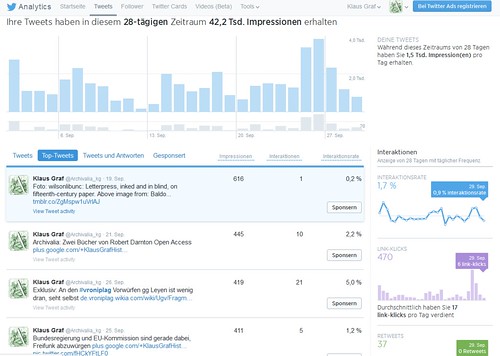
1.) Wer bist Du auf Twitter? Seit wann bist Du auf Twitter? Nutzt Du Twitter vorwiegend privat und/ oder beruflich?

Ich nutze Twitter seit dem Kölner Archiveinsturz 2009 als Archivalia_kg:

https://twitter.com/Archivalia_kg

Überwiegend beruflich.

2.) Zu welchen Themen veröffentlichst Du Deine Tweets?

Quer durch den Garten, Netzpolitik, Historisches, Hinweise auf Archivalia-Beiträge, lustige oder bedenkenswerte RTs.

3.) Wie viel Zeit pro Woche nimmst Du Dir für Twitter?

Eher wenig. Üblicherweise landen Google+-Posts und Tumblr-Posts bei Twitter, Original-Tweets sind eher selten. Ich schau fast jeden Tag kurz in Twitter rein.

4.) Auf welchen weiteren Social Media-Kanälen bist Du aktiv?

Vor allem Google+, ein wenig auch auf Facebook. Wenn man Blogs als solchen Kanal sieht: natürlich hier und manchmal auch in anderen Blogs.

5.) Welche Position nimmt Twitter für Deine Kommunikation in all Deinen Social Media-Kanälen ein?

Twitter ist ein Multiplikator, den ich nicht missen möchte. Und fast immer lese ich auf Twitter etwas für mich Wichtiges.

6.) Organisierst Du Tweetups bzw. nimmst Du daran teil?

Nein, ich organisiere keine. Ich war bei einem eher untypischen Mini-Tweetup (eigentlich: Archivführung) im Stadtarchiv Speyer dabei, aber nicht als Twitterer.

7.) Wofür verwendest Du Twitter vorwiegend?

Um meine Themen zu verbreiten und als wichtige Informationsquelle.

8.) Welche Gesamtnote von 1 – 6 würdest Du Twitter geben und wieso?

Eine glatte 2. Wieso? Weils gut ist.

9.) Welche Tools nutzt Du mit welcher Hardware für Deine Aktivitäten auf Twitter?

Auf dem Desktop-PC bin ich immer auf der Twitter-Website direkt unterwegs, mit dem iPad nutze ich Echofon. Seit neuestem habe ich ein Android-Smartphone mit Twitter-App. Twitter ist ideal, um Wartezeiten zu überbrücken.

Das Stöckchen werfe ich weiter an:

https://twitter.com/MschFr (Schmalenstroer)

https://twitter.com/rotula (Radl)

Mein kürzestes Konradin-Drama aller Zeiten auf Twitter:


http://www.blogtrainer.de/2012/10/18/versteckt-twitter-rss-feeds

(Danke, MR)

http://www.internet-law.de/2013/06/besuch-von-der-polizei-nach-tweet-zur-causa-mollath.html

http://gutjahr.biz/2013/06/mollath-polizei/

Wers kuschelweich im Leben mag, tut gut daran, die offenkundigen Widersprüche zwischen Druckunkultur und digitaler Kultur nicht zu thematisieren und zwar auch dann nicht, wenn sie zum Himmel schreien. Lemy's Blog nimmt denn auch keinen Anstoß daran, wie widersinnig es ist, aus einem gedruckten GWU-Artikel über Technikgeschichte im Internet Links abzutippen:

http://lemys.wordpress.com/2013/06/11/haftnotiz-245-technikgeschichte-literatur-und-internettipp/

Rund 200 junge Menschen, die einem Facebook-Aufruf des Museums [für Vorgeschichte, Halle] folgten, gelang schließlich gemeinsam mit den Museumsmitarbeitern die Evakuierung von rund 10 000 Kisten. Vor allem Studenten aus Jena, Leipzig und Gera kamen dem Aufruf nach. Meller ist beeindruckt von der "angeblich unengagierten Facebook-Generation. Früher hätte man die Bundeswehr holen müssen, heute helfen hunderte Menschen völlig selbstlos".

http://www.dnn-online.de/dresden/web/regional/kultur/detail/-/specific/Viele-Museen-sind-auf-ein-Hochwasser-nicht-vorbereitet-1005791095

The destroyed sixstory cologne city archive
By Frank Domahs, Köln weitere Infos unter: http://www.domahs.de (Own work) [GFDL (http://www.gnu.org/copyleft/fdl.html) or CC-BY-SA-3.0 (http://creativecommons.org/licenses/by-sa/3.0/)], via Wikimedia Commons

Archives are a fantastic resource for us all. They help us grow in knowledge and understanding of past and present. They empower us to investigate the history we need and the stories we care about. Archives are necessary.

But not all archives are well

On March 3 2009, the city archives of Cologne, Germany collapsed, and with it thousands of documents belonging to one of the oldest city archives in Europe. Holdings reached back to 1408/09 and the oldest document stored was from 922. A huge part of the archives was buried by the collaps. Aabout 40.000 charters, collection of photo and film as well as some of the iconic medieval documents and a collection of seals were saved.

To rebuild or not to be rebuild?

But although part of the collections have been saved, the municipality has recently decided to freeze the build of a new city archives. A decision, which has been critized by both the German Association of Archivists (VdA) as well as ICA, the International Council on Archives.

The archives in Cologne can be supported in different ways, among others this petition.

Let’s support all archives in need

But we are almost certain, that there are a lot of archives in the world, which also need attention. Archives threatened by for instance consequences of climate change, lack of appropriate facilities or other negative influences.

#savearchives on June 9

So, on June 9th support the archives in Cologne – and all other archives in need. Tweet about them using the hashtag #savearchives, include blogposts, articles and petitions. We will gather links on this blog and summarize.

Hopefully our attention and support can help #savearchives!

Links:
1) http://askarchivists.wordpress.com/2013/06/03/international-archives-day-dedicated-to-archives-in-need/
2) http://followanarchive.blogspot.de/2013/06/international-archives-day-2013.html

Again: Thanks to Anneke and Charlotte for this great idea.

http://www.heise.de/newsticker/meldung/Experten-gegen-Archivierung-von-Tweets-und-Chats-1874777.html

Seit wann ist der Bundesarchiv-Präsident ein Experte für Twitter?


"WE REALLY WANT GOOGLE TO PICK UP ON THIS – SO PLEASE HELP US PROMOTE THE IDEA!

In 2011 and 2012 we celebrated International Archives Day on June 9th. by doing an #AskArchivists / #FollowAnArchive event on Twitter. We would like to do it again – if archives and archivists support the idea.

But this year we would like the day to be extra special. During the past years, Google has used variations on their logo to draw attention to people and causes worth noticing. Among the doodles are little works of art highlighting things as different as New Year, Chaplins Birthday, Opening of the Arcropolis Museum, Singapore Art Festival and National Library Week. But it seems, that there has never been an doodle on archives.

So why should archives deserve a place on the worlds largest search engine?

1) Archives contain the unique written memories of the world. Our collections are diverse, and contain records on paper, electronic records, sound, pictures and much more. But regardless of form, they are a vital part of our heritage.

2) Archives play a vital part in democracy. Without archives, the world would face immense difficulties in reconstructing our political, economic, social, national, local – or personal – history with a sufficient credibility.

3) Archives are for all. When conducted in accordance with the ICA code of ethics, archives ensure, that our history becomes diverse and open to a variety of interpretations: “Archivists should promote the widest possible access to archival material and provide an impartial service to all users.”

4) Archives provide resource for academic researchers and students, but they are also a fountain knowledge for all, and support livelong, self-directed learning. Whether driven by interest in local history, genealogy or other topics, archives are a place, where thousands of non-scholars gain new knowledge, skills and competences.

5) Google itself is in many ways related to archives, providing access to informations and helping people search and find what they need to grow in knowledge.

So please Google, help us celebrate the content and mission of archives all over the world on June 9th which is the International Archives Day.

HELP GOOGLE WITH IDEAS FOR AN #ARCHIVESDOODLE

We all can help Google with ideas for an archives doodle!
What do you think are specific ingredients for an archives doodle? Draw them, make a picture of them or write it down.
Tweet your ideas from June 1 untill June 8 with the hashtag #archivesdoodle.

WILL INTERNATIONAL ARCHIVES DAY ON JUNE 9 BE CELEBRATED WITH A GOOGLEDOODLE?

Yes! We think archives earn a googledoodle on International Archives Day, June 9!"


Links:
1) http://askarchivists.wordpress.com/2013/06/01/googledoodle-for-international-archives-day-2013/
2) http://followanarchive.blogspot.de/2013/06/googledoodle-for-international-archives.html

Thanks to Anneke and Charlotte for initiating this project!

Eine ausgezeichnete Idee von Maria Rottler:

Ordensgeschichte bei Zotero
http://ordensgeschichte.hypotheses.org/4479

https://moocfellowship.org/

Jeder kann abstimmen, welche 10 Online-Kurse den Wettbewerb gewinnen. Zur germanistischen Mediävistik bewirbt sich ein Kurs über den Erzähler:

https://moocfellowship.org/submissions/der-erzahler-materialitat-und-virtualitat-vom-mittelalter-bis-zur-gegenwart


twoday.net AGB

xml version of this page

xml version of this topic

powered by Antville powered by Helma