

Keine andere zivilisierte Nation leistet sich ein so kompliziertes Regelungswerk bei den Urheberrechtsfristen wie die USA. Auf eine für Digitalisierungsprojekte in einem Teil der USA (z.B. für das in Kalifornien ansässige Internetarchiv) unerfreuliche Entscheidung weist Peter Hirtle hin:
http://blog.librarylaw.com/librarylaw/2009/01/when-is-a-published-work-not-a-publication.html
Ein im Ausland ohne US-Copyright-Notiz veröffentlichtes Werk gilt dort schlicht und einfach nicht als veröffentlicht.
Aus dem Urteil:
"While an ancient work may be protected today under
the ruling of Twin Books, the term is not limitless. Instead, the
copyright term for a newly discovered ancient work that is not
in the public domain or copyrighted would be limited to a
finite term of seventy years after the death of the last author,
§§ 303(a), 302(a), (b), or December 31, 2047, whichever is
later"
Update: Siehe auch
http://blog.librarylaw.com/librarylaw/2009/04/more-messiness-with-copyright-duration-of-foreign-works.html mit Kommentaren
http://blog.librarylaw.com/librarylaw/2009/01/when-is-a-published-work-not-a-publication.html
Ein im Ausland ohne US-Copyright-Notiz veröffentlichtes Werk gilt dort schlicht und einfach nicht als veröffentlicht.
Aus dem Urteil:
"While an ancient work may be protected today under
the ruling of Twin Books, the term is not limitless. Instead, the
copyright term for a newly discovered ancient work that is not
in the public domain or copyrighted would be limited to a
finite term of seventy years after the death of the last author,
§§ 303(a), 302(a), (b), or December 31, 2047, whichever is
later"
Update: Siehe auch
http://blog.librarylaw.com/librarylaw/2009/04/more-messiness-with-copyright-duration-of-foreign-works.html mit Kommentaren
KlausGraf - am Sonntag, 4. Januar 2009, 21:51 - Rubrik: Archivrecht
http://www.nytimes.com/2009/01/04/books/review/Heilbrunn-t.html?_r=1
"Adolf Hitler may be better known to posterity for burning rather than cherishing books, but as Timothy W. Ryback observes in “Hitler’s Private Library,” he owned more than 16,000 volumes at his residences in Berlin and Munich, and at his alpine retreat on the Obersalzberg. Ryback, the author of “The Last Survivor,” a study of the town of Dachau, has immersed himself in the remnants of Hitler’s collection, which are mostly housed at the Library of Congress. In poring over Hitler’s markings and marginalia, Ryback seeks to reconstruct the steps by which he created his mental map of the world. The result is a remarkably absorbing if not wholly persuasive book."
See also
http://www.theatlantic.com/doc/200305/ryback
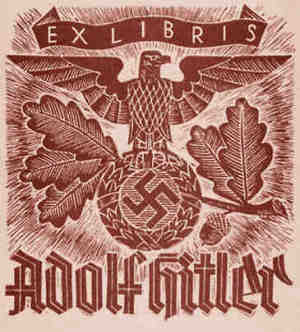
"Adolf Hitler may be better known to posterity for burning rather than cherishing books, but as Timothy W. Ryback observes in “Hitler’s Private Library,” he owned more than 16,000 volumes at his residences in Berlin and Munich, and at his alpine retreat on the Obersalzberg. Ryback, the author of “The Last Survivor,” a study of the town of Dachau, has immersed himself in the remnants of Hitler’s collection, which are mostly housed at the Library of Congress. In poring over Hitler’s markings and marginalia, Ryback seeks to reconstruct the steps by which he created his mental map of the world. The result is a remarkably absorbing if not wholly persuasive book."
See also
http://www.theatlantic.com/doc/200305/ryback
KlausGraf - am Sonntag, 4. Januar 2009, 14:40 - Rubrik: English Corner
noch kein Kommentar - Kommentar verfassen


